3D Workspace
Home
Assets
Affiliate Program
Sign up/Log in
?
Upgrade
DCC Bridge
Anonymous1768474573
01-21 11:54
Model Name
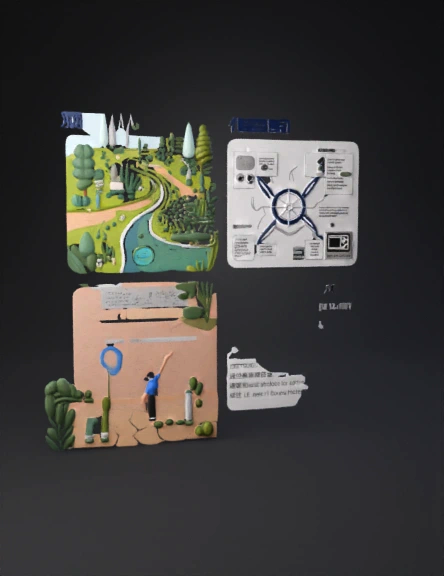
landscape park 3d model
Tags
cartoon
creative
design
landscape scene
nature environment
nature environment cartoon
nature environment rendering
nature environment rendering cartoon
park
rendering
rendering cartoon
Prompt
1. Motion Design Concepts: "Observe to Empower" The "Root-to-Relief" Morph: Animate the transition from a problem to a solution using biophilic transformations. For instance, a cracked, dry landscape (climate change pain) smoothly morphs into a network of lush, green healthcare infrastructure (your business solution). The "Blueprint of Advocacy": Use a modular layout that mimics an architect’s blueprint. Start with rough, hand-drawn strokes observing a community problem, then layer in clean 3D elements as your research identifies the root cause and business model. Epidemiological "Flow" Maps: Instead of static charts, use fluid, organic lines to represent population and epidemiological shifts. These lines should interact with the community figures, showing how your consultancy "relieves the pain" by redirecting these flows toward positive health outcomes. 2. Creative Visual Formats (2026 Trends) Hybrid 2D/3D Storytelling: Combine 2D hand-drawn characters (representing the community) with textured 3D environments (representing infrastructure) to create a "tactile" feel that avoids AI-generated slickness. Cinematic "Thermal" Gradients: Use heat-map inspired gradients—shifting from deep blue to searing red—to represent climate-related health risks, then transition into calming, neutral "safety" tones as your solution is introduced. Micro-Interaction Feedback: In your digital tools or presentations, use subtle motion cues—like soft checkmark pulses or gentle progress bars—to build user confidence and confirm that your advocacy is making a tangible impact. 3. Engagement & Branding Strategy Youth Innovation "Vibe": For the youth entrepreneurship wing, use "Analog Nostalgia"—grainy textures and VHS-style overlays—to evoke a raw, authentic feeling that resonates with younger leaders seeking "real" change. Hyper-Expressive Typography: Let your mission statement ("Relieve the Pain") be the primary visual mark through variable fonts that expand and contract with the "breathing" rhythm of a healthy community. Sustainability Without the Preach: Show sustainability through "circular transitions"—where elements regenerate or loop—symbolizing a resilient, self-sustaining healthcare ecosystem. 4. Implementation Checklist for 2026 Format: Short-form (under 60 seconds) for social media advocacy, and interactive 3D modules for B2B consulting. Accessibility: Ensure all motion includes "reduced motion" alternatives and high-contrast ratios for inclusive public health communication. Tone: Shift from "clinical cold" to "human warm" by using soft blues, neutrals, and nature-inspired textures. 1. Motion Design Concepts: "Observe to Empower" The "Root-to-Relief" Morph: Animate the transition from a problem to a solution using biophilic transformations. For instance, a cracked, dry landscape (climate change pain) smoothly morphs into a network of lush, green healthcare infrastructure (your business solution). The "Blueprint of Advocacy": Use a modular layout that mimics an architect’s blueprint. Start with rough, hand-drawn strokes observing a community problem, then layer in clean 3D elements as your research identifies the root cause and business model. Epidemiological "Flow" Maps: Instead of static charts, use fluid, organic lines to represent population and epidemiological shifts. These lines should interact with the community figures, showing how your consultancy "relieves the pain" by redirecting these flows toward positive health outcomes. 2. Creative Visual Formats (2026 Trends) Hybrid 2D/3D Storytelling: Combine 2D hand-drawn characters (representing the community) with textured 3D environments (representing infrastructure) to create a "tactile" feel that avoids AI-generated slickness. Cinematic "Thermal" Gradients: Use heat-map inspired gradients—shifting from deep blue to searing red—to represent climate-related health risks, then transition into calming, neutral "safety" tones as your solution is introduced. Micro-Interaction Feedback: In your digital tools or presentations, use subtle motion cues—like soft checkmark pulses or gentle progress bars—to build user confidence and confirm that your advocacy is making a tangible impact. 3. Engagement & Branding Strategy Youth Innovation "Vibe": For the youth entrepreneurship wing, use "Analog Nostalgia"—grainy textures and VHS-style overlays—to evoke a raw, authentic feeling that resonates with younger leaders seeking "real" change. Hyper-Expressive Typography: Let your mission statement ("Relieve the Pain") be the primary visual mark through variable fonts that expand and contract with the "breathing" rhythm of a healthy community. Sustainability Without the Preach: Show sustainability through "circular transitions"—where elements regenerate or loop—symbolizing a resilient, self-sustaining healthcare ecosystem. 4. Implementation Checklist for 2026 Format: Short-form (under 60 seconds) for social media advocacy, and interactive 3D modules for B2B consulting. Accessibility: Ensure all motion includes "reduced motion" alternatives and high-contrast ratios for inclusive public health communication. Tone: Shift from "clinical cold" to "human warm" by using soft blues, neutrals, and nature-inspired textures.
Detailed Info
Related Models
Enter invite code
Enter invite code to get credits!
 Anonymous1768474573


 Anonymous1768474573