3D Workspace
Home
Assets
Affiliate Program
Sign up/Log in
?
Upgrade
DCC Bridge
Anonymous1774125859
03-21 20:51
Model Name
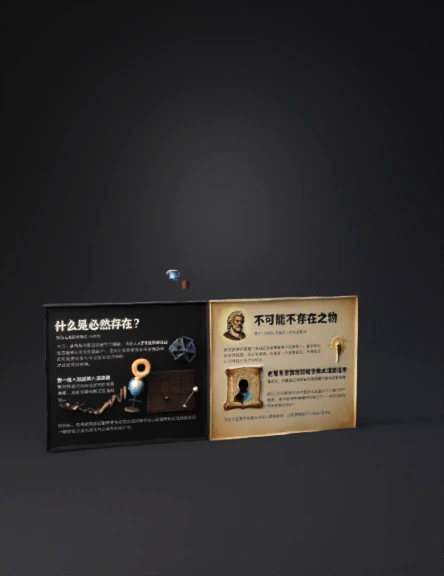
philosophy poster 3d model
Tags
abstract / symbol
concept art
stylized
Prompt
Script Breakdown SCENE 1: Opening Hook (15 seconds) [VISUAL: Black screen fading into a starry universe. A single question appears in elegant white text] TEXT ON SCREEN: "Why does anything exist at all?" [VISUAL: Camera slowly zooms through space toward Earth] NARRATOR (V.O.): "Throughout human history, one question has haunted philosophers, scientists, and ordinary people alike. Why is there something rather than nothing?" SCENE 2: Introducing Key Terms (30 seconds) [VISUAL: Split screen showing two contrasting images] [LEFT SIDE - Dark void with question marks] [RIGHT SIDE - Vibrant world with objects, people, nature] TEXT ON SCREEN: "Contingent Being vs. Necessary Being" NARRATOR (V.O.): "To understand this mystery, we must first understand two fundamental concepts: contingent beings and necessary beings." [VISUAL: An everyday object appears - a coffee cup] NARRATOR (V.O.): "A contingent being is something that exists, but could have not existed. This coffee cup you're holding — it wasn't necessary. It was created, it can be destroyed, and its existence depends on countless other factors." [VISUAL: The coffee cup fades, replaced by a question mark glowing with golden light] NARRATOR (V.O.): "But a necessary being — now that's something entirely different." SCENE 3: What is Necessary Being? (45 seconds) [VISUAL: Golden light expands from the question mark, filling the screen] TEXT ON SCREEN: "NECESSARY BEING" "That which cannot NOT exist" NARRATOR (V.O.): "A necessary being is something that exists by its very nature. It doesn't depend on anything else for its existence. It cannot be otherwise. It simply must exist." [VISUAL: Abstract geometric shapes dancing in perfect harmony] NARRATOR (V.O.): "Think of mathematical truths. Two plus two must equal four. It couldn't be otherwise. The number three — it simply exists necessarily. But what about physical reality? Does anything in our universe work this way?" [VISUAL: Transition to philosophical imagery — ancient scrolls, Greek columns] NARRATOR (V.O.): "This question has driven philosophical inquiry for millennia." SCENE 4: Historical Perspectives (60 seconds) [VISUAL: Animated portrait of Aristotle appears] TEXT ON SCREEN: "Aristotle's Prime Mover" NARRATOR (V.O.): "Aristotle proposed the concept of the 'Prime Mover' — an eternal, necessary being that set everything else in motion. This being doesn't change, doesn't depend on anything, and is pure actuality." [VISUAL: Transition to medieval library setting, quill writing on parchment] TEXT ON SCREEN: "Thomas Aquinas - The Five Ways" NARRATOR (V.O.): "Thomas Aquinas, the medieval philosopher and theologian, developed this further in his famous 'Five Ways.' He argued that we must arrive at a first cause — a necessary being — to explain why anything exists at all." [VISUAL: Chain of dominoes falling, leading to an unmoved first domino] NARRATOR (V.O.): "Everything that exists is caused by something else. But there must be a first cause — something uncaused, something necessary." SCENE 5: The Ontological Argument (45 seconds) [VISUAL: Portrait of Anselm of Canterbury] TEXT ON SCREEN: "Anselm's Ontological Argument" NARRATOR (V.O.): "Perhaps the most fascinating argument comes from Anselm of Canterbury. He proposed what we call the Ontological Argument — a purely logical proof." [VISUAL: Abstract logic symbols and concepts floating] NARRATOR (V.O.): "Imagine the greatest being you can conceive. Now, would it be greater to exist only in your mind, or to exist in reality too? A being that exists in reality is greater than one that exists only in the mind. Therefore, God — the greatest being conceivable — must exist necessarily." [VISUAL: Logic puzzle pieces clicking together] NARRATOR (V.O.): "Of course, this argument has sparked centuries of debate. Critics like Kant argued that existence isn't a predicate — it doesn't add to the concept of a thing." SCENE 6: Modern Perspectives (45 seconds) [VISUAL: Transition to modern university setting] TEXT ON SCREEN: "Contemporary Philosophy" NARRATOR (V.O.): "Today, philosophers continue to grapple with these questions. Some, like Alvin Plantinga, have revived the ontological argument with modern modal logic." [VISUAL: Abstract visualization of multiple universes/possibilities] NARRATOR (V.O.): "Others explore the anthropic principle — the idea that the universe's constants seem perfectly tuned for life, suggesting a necessary designer." [VISUAL: Split screen showing scientific and philosophical imagery] NARRATOR (V.O.): "Meanwhile, physicists explore quantum mechanics and multiverse theories, asking whether necessity might be found in the laws of physics themselves." SCENE 7: The Deeper Question (30 seconds) [VISUAL: Contemplative imagery — person staring at stars, abstract patterns] TEXT ON SCREEN: "Does the necessity of being apply to you?" NARRATOR (V.O.): "But here's where it gets personal. If there is a necessary being — something that simply must exist — what does that mean for us?" [VISUAL: Human silhouette with inner light] NARRATOR (V.O.): "Are we merely contingent accidents in a cosmic accident? Or do we, too, participate in something necessary — some fundamental aspect of reality that cannot be otherwise?" SCENE 8: Conclusion (30 seconds) [VISUAL: Return to the starry universe, but now with warmth and meaning] TEXT ON SCREEN: "The question remains open..." NARRATOR (V.O.): "The existence of necessary being remains one of humanity's greatest open questions. Science explains how things work. Philosophy asks why they exist at all." [VISUAL: Question mark transforms into an open door of light] NARRATOR (V.O.): "Whether you find your answer in theology, philosophy, science, or personal reflection, the question itself points to something profound — the mystery of being itself." [VISUAL: Fade to black] TEXT ON SCREEN: "What do you think exists necessarily?" Production Notes Visual Style Recommendations: Clean, minimalist 2D animation Warm color palette (golds, deep blues, soft whites) Smooth transitions between concepts Abstract visualizations for philosophical ideas Occasional historical imagery for context Audio: Calm, contemplative background music Clear, measured narrator voice Soft sound effects for transitions Text Overlays: Key terms appear as emphasis Quote highlights fade in elegantly Keep text minimal — let visuals tell the story
Detailed Info
Related Models
Enter invite code
Enter invite code to get credits!
 Anonymous1774125859


 Anonymous1774125859