3D Workspace
Home
Assets
Affiliate Program
Sign up/Log in
?
Upgrade
DCC Bridge
Anonymous1770698371
02-10 04:44
Model Name
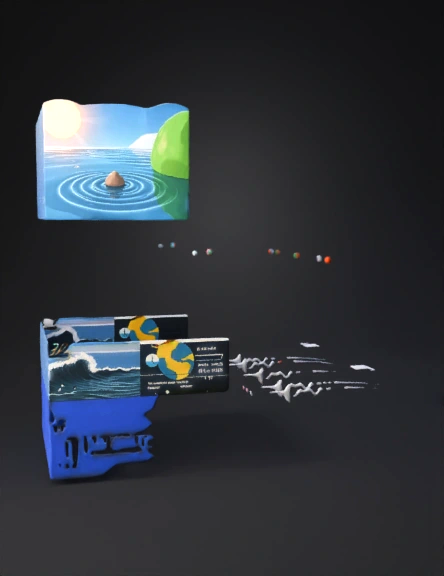
waves infographic 3d model
Tags
nature & environment
rendering
realistic
Prompt
Title: Waves – Properties, Motion, and Tsunamis Format: 16:9, HD, 6–7 minutes Background Music: Light, upbeat, non-distracting Scene 1 – Introduction (0:00 – 0:25) Visuals: Animated pond ripples spreading outward Sound waves represented as moving particles/lines Sunlight rays reaching Earth Text on screen: “Waves are everywhere! 🌊 Energy moves, matter mostly stays.” Narration: “Hi everyone! Today we’re diving into the fascinating world of waves. From water ripples to sound to light, waves carry energy without moving matter. Let’s explore how they work!” Animations: Pond ripples → floating object bobs Sound wave line animation → electric & magnetic fields for light Scene 2 – Wave Motion (0:25 – 1:00) Visuals: Stone thrown into water → ripples Floating boat moves up & down Air molecules oscillating horizontally (sound) Electric & magnetic fields oscillating perpendicular (light) Text Overlay: “Water waves: vertical oscillation” “Sound waves: longitudinal oscillation” “Light waves: transverse, EM waves” Narration: “Wave motion is caused by a vibrating source. Waves carry energy, not matter. Water waves make floating objects move up and down, sound waves make air molecules vibrate back and forth, and light waves are transverse, traveling through space even without air or water.” Scene 3 – Wave Propagation (1:00 – 1:30) Visuals: Particles in medium (dots) oscillating as wave passes Arrows showing energy transfer Narration: “Waves are disturbances that travel through a medium or space. Particles oscillate around their equilibrium positions, transferring energy while matter mostly stays in place.” Animations: Dots move back and forth Bright arrows for energy flow Scene 4 – Wave Characteristics (1:30 – 2:15) Visuals: Water wave: crest, trough, wavelength λ Arrows for amplitude Clock animation for period T Counter for frequency f Narration: “Waves have measurable characteristics: Wavelength (λ): distance between repeating points like crests Amplitude (x₀): maximum displacement Period (T): time to complete one cycle Frequency (f): number of cycles per second Science Tidbit: High-frequency waves carry more energy. A human eardrum can vibrate up to 20,000 times per second!” Scene 5 – Types of Waves (2:15 – 3:00) Visuals: Transverse: particles moving up/down Longitudinal: particles moving horizontally EM waves: electric & magnetic perpendicular oscillations Text Overlay: “Transverse: water, light” “Longitudinal: sound” “Electromagnetic: light, radio” Narration: “Waves are classified as transverse, longitudinal, or electromagnetic. Transverse waves move perpendicular to the wave direction, longitudinal waves move parallel, and EM waves oscillate electric and magnetic fields perpendicular to each other.” Scene 6 – Wave Speed & Examples (3:00 – 3:40) Visuals: Rope oscillation → wave moves along rope Formula overlay: v = f λ Example: f = 5 Hz, λ = 0.5 m → v = 2.5 m/s Narration: “Wave speed is calculated using v = f λ. For example, a rope wave with wavelength 0.5 meters and frequency 5 Hz travels at 2.5 meters per second.” Animations: Arrows show λ distance and particle oscillation Formula animates in and solution appears Scene 7 – Reflection, Refraction, Diffraction (3:40 – 5:00) Visuals: Reflection: wave hits wall → bounces back, incident & reflected angles labeled Refraction: wave entering shallow water → bends Diffraction: wave passing through narrow & wide gaps Sound diffracting around corner Light through slit → diffraction pattern Narration: “Waves can reflect, refract, and diffract. Reflection: bounces off surfaces Refraction: bends when entering a new medium Diffraction: spreads through gaps. Narrow gaps → wide spreading; wide gaps → mostly straight. Sound waves diffract easily, light only if slit size is close to wavelength.” Scene 8 – Tsunamis (5:00 – 6:00) Visuals: Underwater earthquake → ocean floor shifts → waves form Waves moving across ocean, slowing near coast, height increasing Map inset: Lituya Bay, Alaska, 1958 → huge wave illustration Narration: “A tsunami is a series of massive waves caused by underwater disturbances like earthquakes, landslides, volcanoes, or meteor impacts. They travel 500–800 km/h in deep water with low height. Near the coast, they slow down and grow taller, causing destruction. Example: Lituya Bay, Alaska, 1958 — a 1,700-foot wave, largest ever recorded.” Scene 9 – Outro / Summary (6:00 – 6:30) Visuals: Collage: water waves, sound waves, light rays, tsunami animation Text overlay: “Energy moves, matter stays.” Subscribe animation Narration: “That’s a complete overview of waves — their motion, types, properties, and amazing examples like tsunamis! Understanding waves helps us see how energy moves in nature, technology, and disasters. Thanks for watching! Like, subscribe, and hit the bell for more easy physics explanations!” Animations: Smooth collage zooms Particle effects for emphasis Extras for AI Video Tool: Voiceover: Female/male, calm and clear Colors: Transverse = blue, Longitudinal = red, EM = green Background: animated, not static Transitions: smooth wipes, fade-ins for text & formula Highlight keywords dynamically as narration progresses
Detailed Info
Related Models
Enter invite code
Enter invite code to get credits!
 Anonymous1770698371


 Anonymous1770698371